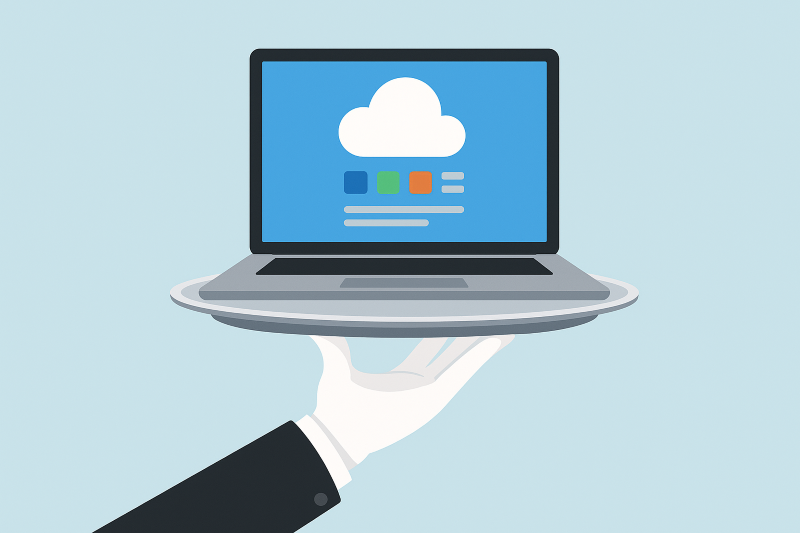
Remember when software came in a box? I remember collecting my first Adobe products and training videos on a shelf next to my homework. But now, even our refrigerators ask for a WiFi connection and check for firmware updates.
In today’s hyper-connected world, all software increasingly behaves like Software-as-a-Service (SaaS). Whether it’s running in the Cloud, on an On-Prem server, or your Local PC, all applications are really part of a larger distributed collection of services. The only real difference is how far they have to reach to get updates ( the ping time ).
I’d like to challenge the traditional definitions of SaaS and illustrate how modern software delivery ( and businesses offering these products ) have universally adopted service-oriented paradigms.
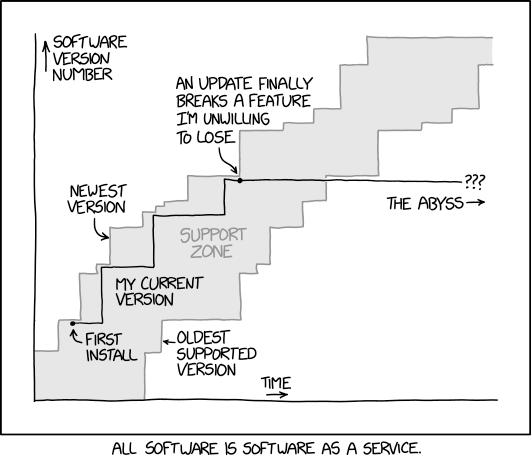
Image Source: XKCD
Traditional Boxed Software vs SaaS
Back in the early 2000s, the traditional “Boxed” software had evolved from floppies to discs and included everything you needed to run straight out of the packaging. Most also included a glossy little license sheet and beautifully printed manual.
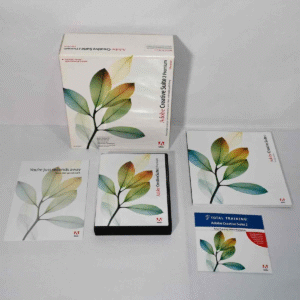
The Adobe CS2 Software Product Box
“SaaS” was considered a special type of Software that supported Multi-tenancy and was charged as a Subscription model, as well as being centrally hosted away from the client’s end-system.
Today though, even locally installed applications now rely heavily on cloud services. Adobe, Microsoft, all the latest video games – they all require a patch or update after you install. Part of this is due to improved security methods and companies getting smart in how they combat piracy. But, it also aligns with the overall adoption of software products being considered services and the expectation that updates are distributed to all customers.
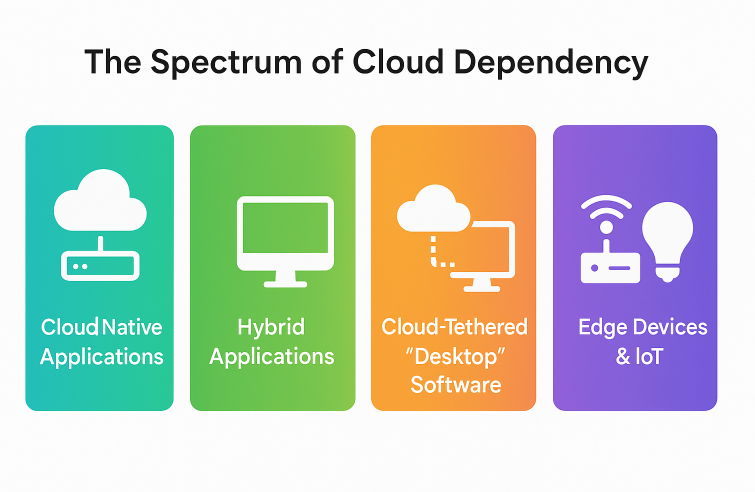
All Modern Software now falls somewhere on what you might call a “Spectrum of Cloud Dependency”. There are Cloud-Native Applications that are 100% hosted and can only be accessed via a web browser. Hybrid Applications include some local components but also have hosted backend APIs ( Slack, Spotify ). Then there’s Cloud-Tethered “Desktop” Software that requires online access for full functionality ( AutoCAD, VS Code Extensions ) as well as Edge Devices & IoT like Smart home tech, wearables, your Tesla, and everything else that connects to your smart phone.
As nostalgic as it is to look back on the days of Boxed software, it has become a thing of the past. Everything now requires some type of connection, either to connect the user to the service’s interface or the core dependencies of the service. Latency has become the primary problem to solve, because the Ping time directly shapes the User Experience. Performance, Resilience, and UX Design all contribute to reducing latency and keeping customers happy. For those of you who feel Local Apps are still a thing, I would challenge you to consider that those applications are really just Low-Ping Cloud Clients. There are a very small number of scenarios where connectivity is antithetical to the business use case, but Offline Mode has become an exception, not the standard.
Implications for Building Software
What does this mean for those of us who build and ship software? Our customers have Always-On Expectations. When they pay for a software product, they expect responsive and intuitive experiences with non-negotiable reliability. This means we need to carefully consider how we operate and what we prioritize.
Do our products have Monitoring & Telemetry so that we can catch issues with our software before customers notice? Are Deployment Pipelines optimally configured so that our delivery process is streamlined? Are Cloud Governance Policies in place so that customer data is not at risk?
An ever-increasing concern with Modern Software is the Security and Compliance impacts of data in the Cloud. It’s important to realize that “Local” does not necessarily mean private and even “offline” software has cloud risks.
The core takeaway is that every piece of software today exists within a service-oriented ecosystem. Whether it’s music streaming in your browser, a spreadsheet on your laptop, or a firmware update on your phone, in our modern world, everything is SaaS – the only distinctions are how far the signal travels and how long it takes to get there.
The future isn’t “cloud vs. local.” It’s about understanding that software is a continuum — and in the age of APIs, integrations, and ever-more-connected experiences, how do we provide the best service?
Be First to Comment